
Level Up Leaders
Submitted By: Arabella Whitlock
Delta Sierra Regional Alliance(San Joaquin Delta)
Website: https://metc.mantecausd.net/
Type of Practice: Learner Transition
Program Area(s): ESL / EL Civics / Citizenship
Region: Northern California
Consortia Involved: Delta Sierra Regional Alliance (San Joaquin Delta)
The Program of Practice
Many ESL students in our adult education program do not fully understand how adult education works, including how to provide a Social Security number, complete required testing, or access support services. Language barriers, cultural differences, and concerns about privacy can prevent students from asking questions or expressing their needs. Furthermore, we think we know what helps students through our own life lens, though it may not necessarily be what is needed.
As a result, students start missing school without staff realizing they face barriers such as transportation, childcare, or personal challenges. In many cases, we only learn about these issues after students have already left. This highlighted a gap in our school: we rely on students to communicate needs they may not yet have the language or confidence to share, limiting our ability to provide timely support.
The Response
Create a student leadership team made up of representatives from each class. These students will learn how the adult education system works, including program expectations and available supports, so they can help communicate this information to their peers.
The leadership team will meet regularly to share school updates, provide feedback on student experiences, and identify barriers such as transportation, childcare, or confusion about program requirements. As peer leaders, they will serve as a bridge between students and staff—offering support to classmates, encouraging communication, and bringing concern to our leadership meeting.
The Unique Features of the Program
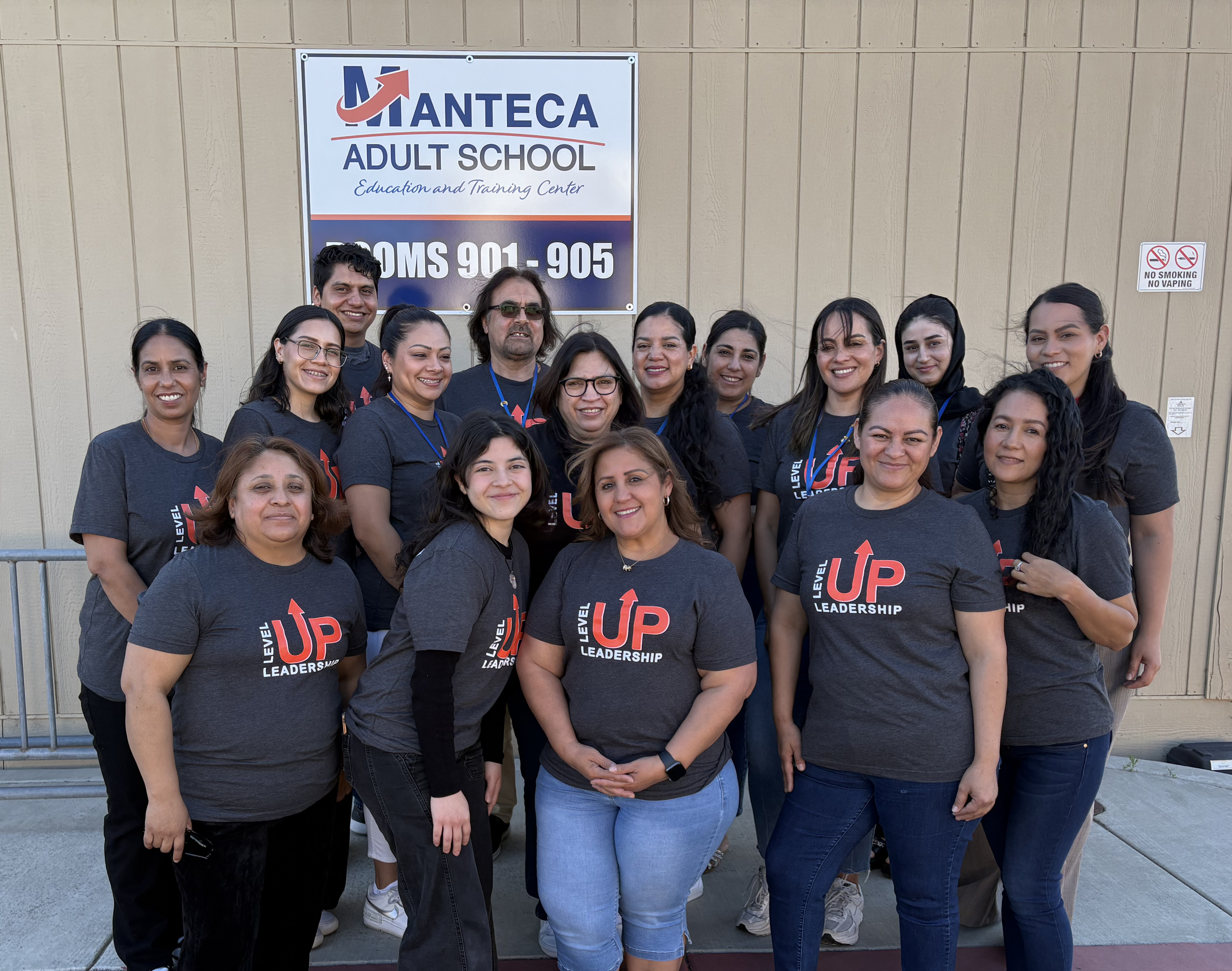
We titled the program Level Up Leaders. To start, teachers chose 2-3 students per class based on attendance and leadership potential. We met with the potential leaders and asked if they could commit to meetings and supporting students and the school. Meetings include agendas with vocabulary support to build English literacy. To promote the program, leaders were given a leadership T-shirt to wear weekly to increase visibility and peer connection. Additionally, training on CASAS pre- and post-testing is provided to help students understand its purpose. A focus remains on identifying student needs in their classes and encouraging peers to seek support. Throughout, student voice is ongoing as leaders share feedback. Finally, leaders are encouraged to work together to build community and find ways to make this "their" school, not just a place they take a class.
The Outcome
Outcome and supporting data: In our first year, 18 ESL students became leaders. They shared the struggles of being an English learner. Two main things they felt would help are getting to practice speaking English. So, they started a coffee-and-conversation event held at different times throughout the year. And the second was that they wanted to celebrate their accomplishments. So we had our first-ever ESL celebration. The leadership team planned this event, made gift baskets, and hosted and greeted guests at the door. Our students received different pins, gift cards, and school t-shirts depending on the accomplishment. We celebrated attendance, gains on their casas tests, achieving citizenship, leveling up to a new teacher, and for those enrolled in our IELCE COAAPS and those who received their paraprofessional certification from our IET. Our leaders even spoke at the end to inspire the other ESL students in attendance. We held a celebration in both the morning and evening.
Throughout the year, the students helped students by ride-sharing and supported moms with gifts for new babies. They attended orientation to help new students who spoke minimal English by translating. The more involved the leaders became, the more we noticed that students were working hard to be successful. Making sure they post-tested and communicated when they had struggles. Not only were our students feeling seen, heard, and celebrated, but it also helped our staff and teachers remember to continue pushing students toward success. We just completed our 2nd year of having leaders, and this year, more students have exited ESL and begun earning their High School equivalency after seeing others achieve success. Once the door was knocked down, the students weren't afraid to move on. Seven of our leaders from our first year received their HS equivalency this school year, and 2 are working for our school district. We firmly believe it was the Leadership team that helped us see and continue to see how to help students succeed, feel supported, and accomplish their dreams in learning English and more!